‘The lights were like a sea – and the sea is invincible.’
It was with these impactful words that Friedrich ‘Fritz’ Verzetnitsch, then President of the Austrian Trade Union Federation (ÖGB), described one of the greatest civil society events in the history of the Second Austrian Republic: the ‘sea of lights’, which took place in Vienna on 23 January 1993.
Up to 300,000 people gathered on Heldenplatz square and in the adjacent streets in Vienna’s First District to send out a powerful signal against xenophobia, exclusion and an increasingly polarising migration policy using candles, torches and their silent presence.
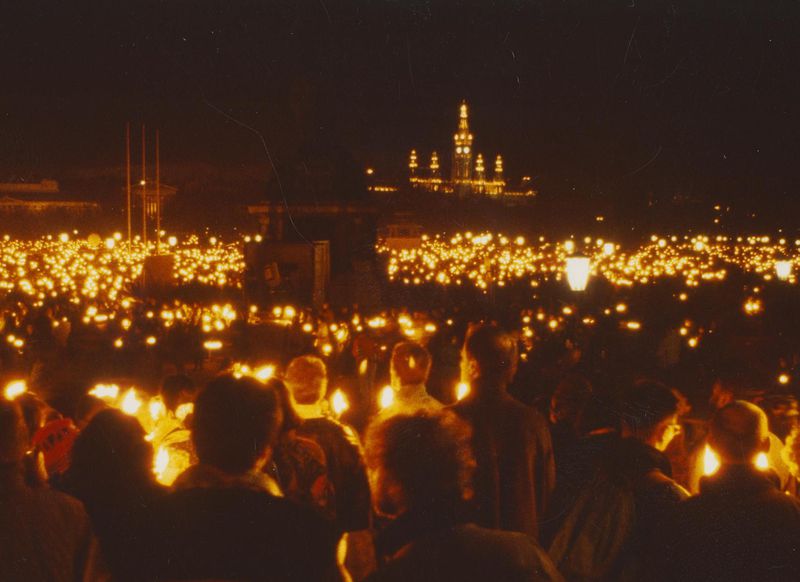
Volkskundemuseum Wien (Austrian Museum of Folk Life and Folk Art) defined itself as a socially and democratically engaged institution at the time and used the opportunity to document this significant event. Several employees of the museum – some with museum equipment, some with their own – set out to capture and photograph the event, focusing on the participants, the light display, the atmosphere and the materials distributed by the organiser, the human rights organisation SOS Mitmensch.
The material that was preserved includes strip negatives, contact prints and positives as well as eight postcards and one sticker. The photographs were taken by former museum employees Bernhard Tschofen (pos/68439/001–015), Margot Schindler (pos/68439/016–028) and Franz Grieshofer (pos/68439/029–067).
Response to Austria First petition
The demonstration was a direct response to the Austria First petition initiated by the right-wing populist Freedom Party (FPÖ), which, under the leadership of party and parliamentary group leader Jörg Haider, called for a drastic halt to immigration and further restrictive changes to asylum and immigration policy. Chains of lights that had spread through major German cities a year prior in response to right-wing extremist violence served as a role model for the rally.
Broad public support
The sea of lights was organised by the non-partisan initiative SOS Mitmensch, whose goal was to shift social discourse towards tolerance, humanity and solidarity and to demonstrate civil resistance to right-wing and restrictive politics. The initiative was supported by trade unions, religious communities, artists and intellectuals. Key co-initiators included musician and human rights activist Willi Resetarits, writer Josef Haslinger, the then Caritas president and priest Helmut Schüller, and ÖVP (Austrian People’s Party) politician Marilies Flemming.
A series of postcards entitled We Foreigners..., designed by Reinhard Eberhart for SOS Mitmensch, was distributed during the event and served as a unique means of communication. With humour and precision, the postcards played with prejudice and raised questions about belonging, preconceptions and social identity. The museum owns a total of eight postcards from this series depicting different motifs (pos/68439/068-075).
Response and impact
The media response to the sea of lights was overwhelmingly positive. The rally was hailed as a powerful, peaceful sign representing civil society’s commitment to fundamental democratic values. The event had an impact at political level, too: the Austria First petition received 416,531 signatures, significantly less than the Freedom Party had expected.
In the long term, the sea of lights contributed to the strengthening of civil society initiatives. Organisations such as Integrationshaus and Armutskonferenz were established in the aftermath, and the event had a lasting influence on the political debate on human rights, integration and social participation. The sea of lights now occupies a firm place as a symbol of resistance to right-wing populist tendencies in the history of democracy in Austria.
A second chance: 2026 exhibition outlook
The original intention of Volkskundemuseum Wien in 1993 was to incorporate this documentary material into a new concept for the permanent exhibition planned a few years later. They were to be included as a visual source in a history of knowledge prelude, which was part of a smaller research project on everyday culture and political participation intended to reveal novel approaches to recent democratic history. However, the concept was never brought to life. The material was archived but not processed or exhibited in the museum. It remained an unused historic document – until now.
The project has now been revisited as part of the planned museum reopening in 2026. The documents have been systematically catalogued, contextualised and integrated into the museum. The aim is to present them not only as a historic source, but also as a starting point for a socio-historical reflection on forms of protest, civil mobilisation and political participation in the 1990s.
More than three decades after its creation, the sea of lights is thus gaining new visibility in institutional memory. The planned museum exhibition and its integration into the Online Collection make it clear that the history of democracy is written not only in parliamentary speeches, but also in public spaces illuminated by candlelight.
Tamara Hauer
Photo collection management
28 April 2025