Bauchranzen: splendour worn around the waist
Bauchranzen are wide, usually intricately crafted leather-buckled belts that are still worn today, mainly in parts of Austria, Italy, Germany, Czechia, Romania and Poland. They serve both practical and representative purposes. Their production requires a considerable amount of time, material and labour, which, particularly in the past, reflected the social status of the wearer. In addition to being a decorative leather accessory and a means of storage and transport, these belts often have a personal and symbolic meaning and express belonging. Their elaborate embellishments range from quill, gold and Zirm embroidery to pewter or brass studs. This type of belt is still worn today as part of traditional costume and marksmen’s clubs (Trachten- and Schützenvereine) or on festive occasions.
Volkskundemuseum Wien (Austrian Museum of Folk Life and Folk Art) has acquired a wide variety of Bauchranzen since its foundation in 1894. While the Textile and Clothing Collection contains around 230 items, the Online Collection Plus comprises 50 selected examples (as of April 2026) that provide insight into the different places where these belts were manufactured, their use, shapes, materials, techniques and motifs.
Broadly studded
Bauchranzen have straps embroidered with small pewter studs and are colloquially referred to in German as Zinnnägel-Fatsche or Zinnfatsche (cf. ÖMV/355). The German word Fatsche refers to a wide, straight, leather-stitched buckle belt. Gurt, Binde and Ranzen are synonyms used for this kind of studded belt, which is why waist belts decorated with pewter (Zinn) studs are also known as Zinnstiftranzen or Zinngurt. Nagelbinde is a term used to describe belts fitted with both pewter and brass studs (see ÖMV/2016).
Belts of this kind were produced by saddlers or harness-makers (Sattler or Riemenmacher, also known as Riemer or Riemenschneider). The latter in particular specialised in making fashion items and belts out of leather. Some specialised as belt-makers (Gürtler) and offered pieces with studs or embroidery.
In addition to studding, other techniques were applied to decorate the wide belts. The museum’s collections include, for example, embossed belt straps (see ÖMV/30141), some of which are embellished with glass stones (see ÖMV/23672), leather appliqués or Zirm embroidery (see ÖMV/11635). Zirm refers to narrow, often dyed, strips of leather.
According to the inventory book, two of the studded belts (see ÖMV/4339 and ÖMV/4340) are part of a women’s ensemble from Rum in Tyrol. In addition to the two belts, the ensemble comprises two bonnets, two scarves, two jackets, an apron, two skirts, another two belts, three shirts, a hat and cutlery. The Textile and Clothing Collection at Volkskundemuseum Wien holds a number of such ensembles. It is not always clear, however, whether these items were actually worn together by a single person in real life, or whether they form a selection that has, for example, been put together specifically for the museum. From today’s perspective, combining individual items in a museum is highly problematic, as it suggests a connection that may never have existed. Furthermore, the information recorded in the inventory books, particularly from the museum’s early days, must be treated with caution. The two belts outlined above were acquired in 1896. It is not possible to ascertain whether these two belts were ever worn in combination with the other garments and accessories mentioned.
Studded Bauchranzen were in fashion between the early 18th and the early 19th centuries.
Feathers in leather?
Towards the end of the 18th century, Bauchranzen featuring quill embroidery became popular and eventually replaced studded belts. What makes this technique special is the material used. Instead of embroidering using narrow strips of leather, silk or cotton thread, split quills from peacock feathers were used. These quills were chosen because of their material properties: compared to other feathers, peacock feathers are long, and it’s possible to obtain uniform, thin threads suitable for embroidery from the individual quills. Furthermore, peacock quills are both robust and flexible – properties which the embroidery threads produced from them retain, which, in turn, makes the embroidery durable. Nevertheless, the leather is pricked with an awl before the threads are weaved through. The Austrian UNESCO Commission has included this embroidery technique in the Register of Intangible Cultural Heritage in Austria since 2019. In addition to Bauchranzen, other leather products, such as bags, have been and continue to be embroidered in this way.
As with studded Bauchranzen, there are colloquial German terms for quill-embroidered belts, such as Blattlranzen (see ÖMV/29), Schlauchfatsche (see ÖMV/2000) or Fatsche (see ÖMV/12149). Additional techniques and materials have been used in some items in the museum’s collections alongside quill embroidery; for example, gold threads (see ÖMV/26604), leather appliqués (see ÖMV/20243) and Zirm (see ÖMV/2141).
Geldkatze: a practical satchel
Many of the Bauchranzen that are part of the museum’s Textile and Clothing Collection feature obvious (see ÖMV/87405/001) or hidden pockets and compartments fastened with buttons (see ÖMV/4351) or leather straps (see ÖMV/26459). They were used for storing and carrying items like documents or money. The term Geldkatze (money pouch) is not exclusively applied to Bauchranzen. Other, simpler and narrower belts with compartments or sewn-in pockets were also referred to as Geldkatzen in German, at least until the end of the 18th century.
(Re)Presentation
Some Bauchranzen feature heraldic or Christian motifs that provide an indication of the wearer’s affiliation. Some show a double-headed eagle, for example. The belt with inventory number ÖMV/19437 prominently features a haloed, crowned double-headed eagle holding a sword and sceptre in the middle of the strap. This heraldic animal and the insignia can clearly be attributed to the Holy Roman Empire. Accordingly, it can be assumed that this item was produced and worn within the territory of the Empire; this corresponds to the place of manufacture and use in Salzburg, as stated in the inventory book. A popular Christian motif on Bauchranzen, thus a way of showing one’s religious affiliation, was the Christogram (see ÖMV/2020).
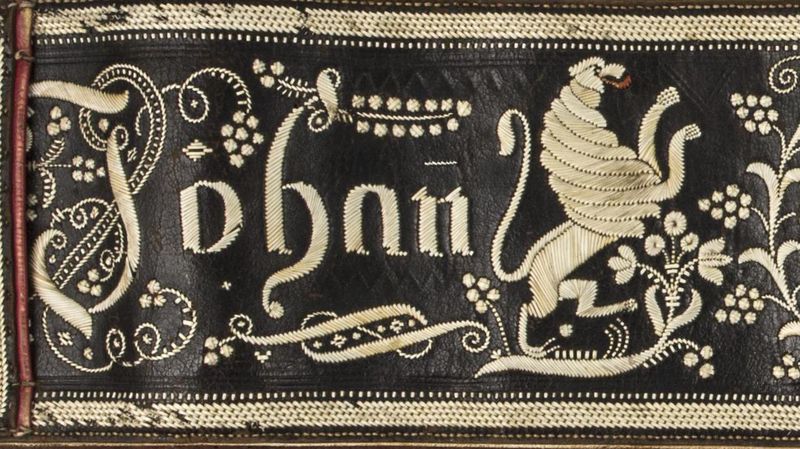
Alongside a wide variety of motifs, having one’s own name (see ÖMV/2019) or one’s own initials (ÖMV/2140) written on the belt was popular, which provides insight into the wearer’s self-image.
To this day, Bauchranzen are a means of expression and communication. It is still popular to decorate belts with the motifs mentioned or one’s own name. Another trend that has endured to the present day, which emerged from the mid-19th century onwards: the belt panel (colloquially known in German as Ranzenblattl) was used not only for names, initials or individual words (cf. ÖMV/5878) but also for short sayings (cf. ÖMV/20388), which often provide an indication of the wearer’s profession. Furthermore, alongside the chosen motifs and inscriptions, aspects such as craftsmanship, the quality of materials used and the time invested in production also reveal a person’s social status or financial background. However, not every belt was a unique piece. Collections from other museums show that certain motifs, ornaments and inscriptions appear repeatedly, and some designs were mass-produced as early as the 19th century.
Combinations also existed, of course, as the example of this Fatsche with inventory number ÖMV/34717 shows; it contains both a first name and a surname, as well as a single word. At the same time, this example demonstrates just how labour- and material-intensive the production of a belt could be.
Wide belts also served a practical purpose for certain occupational groups: wearing a wide belt stabilises and supports the upper body and protects against draughts, cold and knife blows to the abdomen. All these qualities were advantageous during long journeys on carts, for example. Among the 50 selected belts there is one item which – according to its former owner, Auguste Kochanowska (1868–1917) – is associated with a specific occupation. In a letter to Volkskundemuseum Wien, she describes the belt with inventory number ÖMV/32981 as a shepherd’s belt from what is now Romania.
Regardless of their (German) names – the Bauchranzen found in the Textile and Clothing Collection held by Volkskundemuseum Wien offer subtle insights into who wore them, as well as their wearer’s sense of identity, the trends they followed and the local traditions they preferred.
Maria Raid
Research and Curatorial Team: Collections, Archive, Provenance Research & Restitution
27 April 2026
Further reading on quill-embroidered and studded Bauchranzen: