Porcelain beer stein lid medallions – a reflection of social life
Beer steins with porcelain lids were an integral part of Gasthaus (inn) culture up until the early 20th century. From the second half of the 19th century onwards, beer steins made of colourless glass with pewter holders came into fashion; their round-shaped porcelain inserts – known as medallions – often contained personalised motifs. These miniature depictions showing landscapes, hunting scenes or humorous motifs not only served as decoration but also as status symbols. They reflected the preferences, professions and social status of their owners. The motifs ranged from Alpine landscapes and guild symbols to erotic or satirical scenes, offering insights into the aspirations and sense of humour of the male regulars at that time. Some of these motifs are problematic as they show racist or sexist depictions; they are marked accordingly with a disclaimer. The collection at Volkskundemuseum Wien (Austrian Museum of Folk Life and Folk Art) comprises 969 porcelain and two glass medallions, which were in use during the period before the First World War. Today, they offer a unique insight into 19th-century beer drinking culture and the world of imagination of that time.
Beer stein lids as a cultural phenomenon
Porcelain beer stein lids became popular with the rise in beer consumption and industrialisation in the 19th century. Beer was consumed at inns and club premises and served an integrative purpose in student fraternities, at regulars’ tables and when playing card games. Technological innovations, such as storage cellars, cooling machines, beer filters and the use of bottom-fermenting yeast, improved the quality of the beer, making the formerly cloudy beer look clear. While stoneware beer steins were gradually replaced by glass ones, the lids evolved into personal identifiers. Most of the medallions, usually six to seven centimetres in size, were mass-produced: after the first firing, they were glazed, then motifs were applied using transfer printing, before porcelain painters coloured them. The depictions ranged from Alpine landscapes bathed in a romantic evening glow to caricatured figures, and they served as a source of entertainment and a means of identification. They portray an idealised natural world that acted as a counterpoint to the modern urban environment and also featured scenes that perpetuated the clichés and prejudices of the time.
Motifs and symbolism
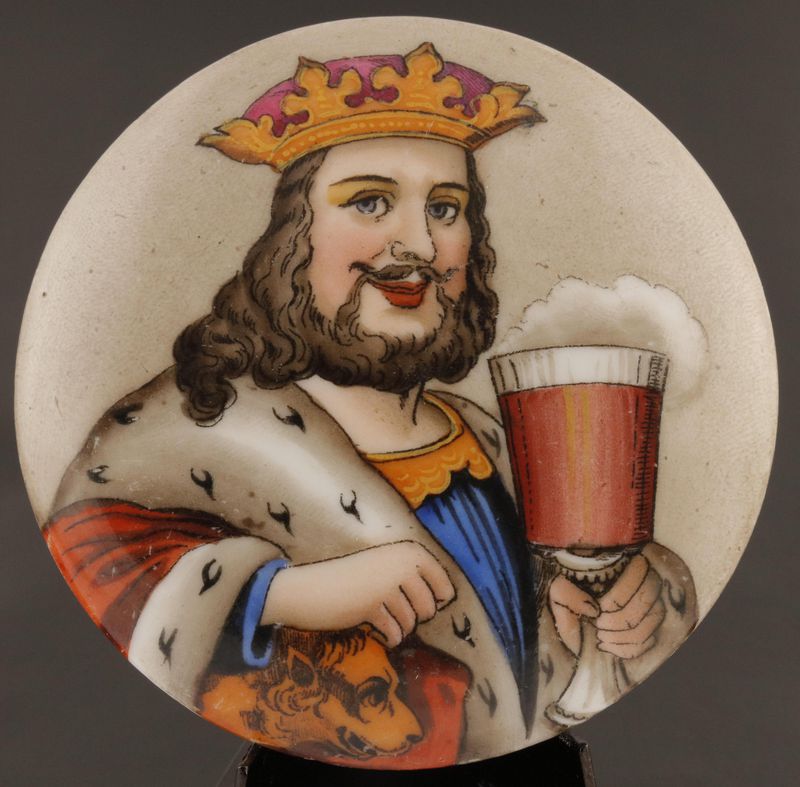
The medallions contain quite an impressive range of motifs: mountains and forests as places of longing, landscapes, cities, inn scenes, hunting scenes, depictions of animals, portraits, guild and trade symbols, neutral floral motifs, as well as erotic or humorous scenes, which sometimes used both sides of the lids: veiled on the outside, revealing on the inside. Under the pretext of eroticism, women were frequently depicted in a sexualised manner and reduced to their physical appearance, whilst men were portrayed as hunters, fishermen or scholars; occasionally, they were caricatured in a humorous manner. The legendary King Gambrinus, often mistakenly referred to as the ‘inventor’ of beer, was also frequently portrayed. Many motifs reflect a sense of pride in one’s profession (farmers, craftsmen) or satirise social groups (townspeople as clumsy hunters). Today, it’s difficult to comprehend the mainly sexualised depictions of girls and women (females as objects of desire) and political allusions. The motifs were intended to be seen both whilst the stein was in use and when it was displayed on the storage rack at the inn.
Production and customisation
Medallions were produced in several steps: first, they were moulded, then glazed, before the either hand-painted or printed decoration was applied. Templates based on lithographs, copperplate prints or etchings were transfer-printed onto the lid and then coloured. Porcelain painters worked in porcelain factories or independently; they sold the pieces to dealers or private individuals. Regulars chose their designs from the innkeepers’ catalogues or had unique pieces made to order. Some of the lids outlasted the steins and became collectors’ items. The pieces shown here owe their survival to the Patriotic War Metal Collection compiled during the First World War, when pewter was requisitioned for military purposes. The art historian Alfred Walcher von Molthein saved the porcelain medallions for Volkskundemuseum Wien – despite the damage caused when they were broken out of their pewter holders.
Collection history and significance
The collection at Volkskundemuseum Wien documents not only craftsmanship from that time but also social trends: Biedermeier cheerfulness, emerging tourism in the Alps, prevailing gender inequalities, and the role of inns as a social space and meeting place. The medallions are tangible witnesses to popular culture in southern Germany and Austria, telling tales of celebrations, anniversaries and everyday life in an era when beer stein lids were more than mere covers – they were an expression of identity, enjoyment and social life.
Claudia Peschel-Wacha
Curator and Head of the Ceramics Collection at Volkskundemuseum Wien (retired)
28 April 2026
References: