Embroidery Patterns
The pattern sheets for canvas embroidery held by Volkskundemuseum Wien (Austrian Museum of Folk Life and Folk Art) provide insight into the wide range of diverse motifs found in embroidery patterns, which were mass-produced from the Biedermeier period onwards. In fact, there were countless figurative, floral and ornamental patterns on point paper to choose from in the 19th century. The embroidery patterns were used by both upper-class ladies for doing needlework as a leisure activity in company of others, befitting their social standing, and by embroiderers who had to earn a living from it.
The museum’s collection comprises around 200 embroidery patterns for canvas embroidery. These consist of individual sheets in different formats, the majority of which are hand-coloured stippled patterns. Most of the sheets originate from the catalogues of well-known publishers and art dealers based in Vienna and Berlin. This article focuses in particular on the embroidery patterns from the first half of the 19th century.
Women’s needlework: a social pastime or paid work
The embroidery patterns used during the Biedermeier period – lush rose blossoms, idealised landscapes and symbols of friendship – seem to correspond with the later romanticised image of this time. Those who could afford to do so sought to shut out economic hardship and political oppression by retreating into the domestic sphere and family life.
The image of the lady of the house sitting by the window, embroidering to pass the time, surrounded by the comfort of her family or good company, must not obscure the hardships faced by many women in the 19th century. While the ladies of the upper middle classes demonstrated through their leisure to embroider that they did not need to perform more menial tasks, their confinement to the home was in fact enforced. After all, with a few justifiable exceptions, it was considered unbecoming of a lady to learn or pursue a profession. For many women of more modest means, however, daily work at the embroidery frame was by no means a leisure activity. Female homeworkers often had to work for companies and wholesalers for a meagre wage in order to make a living. What they all had in common, however, were the patterns they used for their embroidery. The pattern sheets held by Volkskundemuseum Wien originate from private households rather than from factories. It can therefore be assumed that these patterns were intended for domestic needlework.
A world of colour
In well-to-do middle-class homes during the 19th century, everyday sewing tasks were carried out either by domestic servants or the lady of the house during the day. When it came to fine needlework as a leisure activity for ladies, however, the situation was quite different. Embroidery, knitting and crochet were practised in presence of the family, on social occasions, such as tea parties or coffee gatherings, as well as at festivities in salons. Canvas embroidery based on coloured patterns was one such form of showcasing this pastime craft. It required suitable patterns, which were sold in great numbers and with an ever-changing variety of motifs. In addition to patterns produced by the thriving publishing industry in Berlin, Viennese customers could also purchase their sheets from a number of local art dealers. Volkskundemuseum Wien holds a cross-section of the range in its collection, predominantly of Berlin and Viennese origin.
Canvas (stramin) embroidery, or tapestry work, refers to all techniques in which the stitches cover the entire base fabric and use counted threads. Embroidery was carried out, for example, using cross-stitch, pearl stitch, Gobelin stitch and satin stitch, as well as special stitches used to imitate Oriental carpets. (Dillmont, n. a.: 199) Embroidery canvas is a stiff, grid-like fabric which varies in thickness and fineness depending on whether it is used for embroidery or knotting. Due to the growing popularity of multicoloured embroidery on canvas, art dealers and publishers began supplying their customers with affordable single sheet patterns featuring pre-coloured motifs on paper in the early 19th century. Initially, they were hand-coloured; later, stencil-coloured and printed patterns on single sheets, in pattern books and as supplements to fashion magazines became widespread.
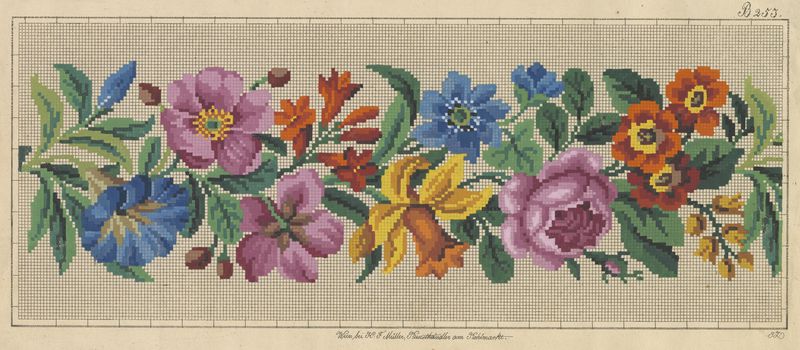
Manufacturers used point paper with a square grid for embroidery patterns. This gridded graph paper (papier quarrée) makes it easier to transform a freehand drawing into an embroidery pattern and to count the stitches whilst embroidering. One square on the pattern corresponds to one stitch on the canvas. Once the design had been created, preparations were made for copper plate printing, during which either just the outlines of the motifs or outlines and colour specifications, indicated by a system of different symbols to assist the colourists, were engraved onto the plates. This colour coding is usually still clearly visible beneath the colouring. Copper engravers carried out the rest of the work before embroidery pattern colourers were tasked with colouring the prints. For the colouring, gouache or watercolours were mixed with gum water and applied or stippled square by square using a fine hair brush. This is where the term ‘stippled pattern’ comes from.
As early as 1829, Carl Uffenheimer was granted a patent in Vienna for his invention, namely “Stickmuster auf Papier oder auf jeden andern Stoff mittels einer neuen Art, statt mit freyer Hand zu illuminieren, durch Patronen aufzutragen, wodurch sie fehlerfrey erzeugt werden, und bey der größten Vollkommenheit viel weniger kosten” (n. y. 1829: 835).[1] The following two sheets from this publisher (ÖMV/87238/040, ÖMV/87238/041) do indeed contain no engraved colour specifications. To make transferring the designs from the pattern to the fabric easier, manufacturers extended the lines of the point paper ten squares beyond the grid. The design numbers indicated at the top right-hand corner of the embroidery patterns generally do not provide any indication of the date or the publisher’s product range, as they were not numbered consecutively. Some patterns found in the museum feature price details.
The items held by Volkskundemuseum Wien clearly show just how popular floral motifs in all their variety were. They confirm that floral designs during the Biedermeier period, and beyond, rarely omitted roses. The collection features arrangements of forget-me-nots, daffodils, lilies, primroses and many other floral motifs – rendered with varying degrees of naturalism. Designs for bouquets, wreaths of flowers, lavish borders and fine ribbon patterns are found in ever-changing combinations. One sheet depicts exotic plants, such as a pitcher plant or the flower of a Gloriosa superba (flame lily) (ÖMV/87238/082).
In keeping with the Biedermeier style, emblems of friendship, love and remembrance are frequently found, featuring typical commemorative stones, urns, columns, weeping willows and cornucopias. Idealised landscapes including buildings, genre scenes, animal and hunting motifs, chinoiserie and romanticised scenes of rural life are just as present as street-vendor figures, religious motifs and ornamental pattern repeats. The intended application of the patterns is not always clear. However, their use is quite obvious in the following examples of patterns for house slippers (ÖMV/87238/069), pouches and bags (ÖMV/87238/083), wallets (ÖMV/87238/081) and notebooks (ÖMV/43386/002, ÖMV/43386/003).
From art dealers and publishers
The potentially oldest embroidery pattern held by Volkskundemuseum Wien was produced in Augsburg, Germany, and was published by the heirs of Johann Christoph Haffner between 1754 and 1800. It depicts monochrome, stippled black flower shoots, which were presumably intended as a template for linen embroidery (ÖMV/87238/019). The following paragraph, however, focuses on the coloured canvas embroidery patterns from the first half of the 19th century.
Berlin was a leading centre for the production of embroidery patterns in the 19th century. A. Philipson, a Berlin-based designer and publisher of embroidery, published his coloured counted-thread patterns as early as 1804. Volkskundemuseum Wien holds only one later sheet from this publisher (ÖMV/87238/082). The quality of the Berlin embroidery patterns was also well known in Vienna. Anton Paterno, a Viennese art dealer who sold embroidery patterns alongside picture sheets, games and greeting cards, announced in the Wiener Zeitung newspaper in 1826 that he had “soeben von Berlin eine bedeutende Sendung neuer besonders schöner Stickmuster”[2] (n. a. 1826: 376). Anton Paterno ran his art dealership on Neuer Markt in Vienna from 1819 until his passing in 1835, after which his widow continued to run the publishing business. Some of the embroidery patterns in the museum’s collection appear in his 1832 publishing catalogue, which can be viewed in the Wienbibliothek library’s digital collection. (Anton Paterno Art Dealership 1832)
Vienna was certainly able to assert its position as an embroidery pattern production hub against its Berlin competitors. A newspaper report from 1839 concerning the “Stick-, Strick- und Teppichmustern auf Papier von Heinrich Friedrich Müller, Kunst- und Musikalien-Händler am Kohlmarkt Nr. 1149”[3], published in connection with the Second Exhibition of Industrial and Commercial Products, refers to the competition between the two places. The author expresses his indignation: “Es ist gegenwärtig in mehreren teutschen Zeitschriften ein Artikel zu lesen, worin Berlin als Hauptsitz der Stickmusterverleger genannt und angegeben wird, daß von dort aus die derartigen Erzeugnisse nach allen Seiten der civilisierten Welt versendet werden, weswegen die dortigen Verleger keine Konkurrenz zu fürchten hätten. Diese Behauptung klingt wirklich sehr sonderbar, wenn man erwägt, daß Berlin nicht der einzige Ort Europa‘s ist, von dem die kultivierte Damenwelt unseres Erdballs mit Stickmustern versehen wird, indem sich in Wien die obbenannte Kunsthandlung befindet, welche schon seit circa 30 Jahren den Stickmusterverlag im größten Umfange betreibt, und welcher dieser Kunstzweig eigentlich seine Entstehung verdankt. […] Mit Ausnahme von Spanien und Portugal unterhält diese Kunsthandlung in allen europäischen Ländern Handelsverbindungen, und hat namentlich in Paris, London, Petersburg, Moskau, Hamburg u.s.w. Depots. Die ausgestellte bedeutende Anzahl von Stickmustern enthielt Bouquets, welche die Berliner an geschmackvoller Zusammenstellung übertreffen.“[4] (Kolb 1839: 550)
Heinrich Friedrich Müller was one of the early Viennese producers and vendors of coloured embroidery patterns. The varied high-quality patterns are the most frequently represented in the museum’s collection. Some of them appear in one of his embroidery pattern catalogues, which can be found in the Bavarian State Library’s digital collection. (Müller, Heinrich Friedrich, n. a.) Müller, who was born in Hanover, moved to Vienna in 1805 and took over an art dealership on Kohlmarkt in 1807. Some of the sheets bear the initials ‘IZ’, referring to one of around 150 engravers and colourists employed there. Jeremias Bermann, who took over the business belonging to his father-in-law Joseph Eder in 1815, also offered a wide range of embroidery patterns in various designs and qualities.
Two Berlin publishers also need to be mentioned, as the museum’s collection contains the largest number of patterns from them, and they played a significant role for Berlin as a centre of production. Ludwig Wilhelm Wittich’s art publishing house produced high-quality embroidery patterns from 1810 onwards. His extensive repertoire included, amongst other things, imaginative chinoiserie designs as well as romanticised male and female street-vendor figures offering their products as itinerant market traders. Almost as many sheets originate from the publishing house belonging to M. Levy, who distributed illustrations similar to those of Wittich. The museum’s collection contains various designs by him, including genre scenes.
Nora Witzmann
Curator of the Image, Print, Paper Collection
10 June 2025
[1] “illuminating embroidery patterns on paper or any other fabric using a new method; instead of being applied freehand, they are applied by means of stencils, whereby they are produced without error and, whilst achieving the greatest perfection, cost much less” (translation)
References: