Capturing the Velvet Revolution: Photographs from Bratislava and Prague in 1989
In the autumn of 1989, people took to the streets in former Czechoslovakia to express their discontent with the ruling totalitarian system. These events were captured on camera by a number of courageous individuals. A total of 161 photographs showing protests, banners and posters from the Velvet Revolution are now part of the Photo Collection of Volkskundemuseum Wien (Austrian Museum of Folk Life and Folk Art). These pictures are far more than mere historical records: even decades later, they bring the atmosphere of those weeks of change back to life.
The revolution
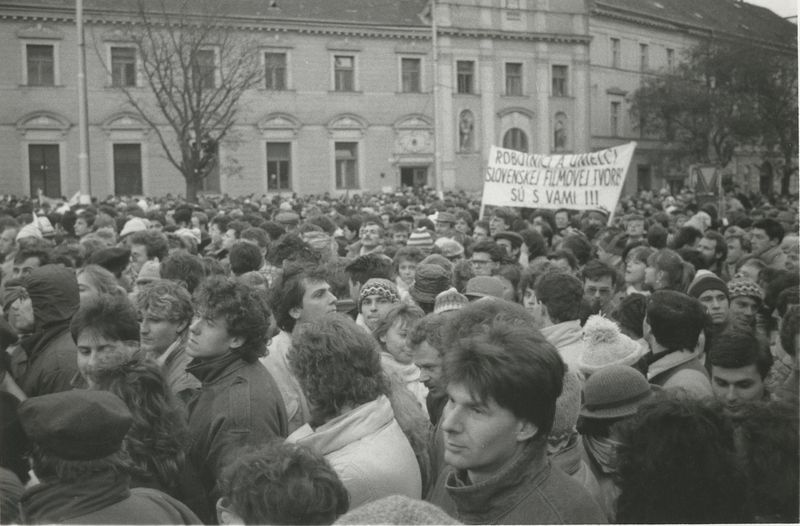
Decades of resistance against the communist regime came to a head in Prague and Bratislava in November 1989. Within days of the harsh police crackdown on students in Prague on 17 November, city squares filled with tens of thousands of people. Candlelight, banners and calls for freedom characterised the protests. New citizens’ movements – the Civic Forum (Občanské fórum, OF) in Czechia and Public Against Violence (Verejnosť proti násiliu, VPN) in Slovakia – emerged, giving people’s concerns and grievances a voice (pos/68370/001).
The peaceful protests led to negotiations between civil society groups and the government. A large rally that took place on 1 December 1989 and the removal of the barbed wire along the border with Austria marked the beginning of a new era. The first free elections took place a few months later. As a result, in 1993, Czechoslovakia split into two independent states: the Czech Republic and Slovakia.
Austria has close historical ties with both countries and Volkskundemuseum Wien holds numerous historical artefacts from these regions in its collections. This is why political trends in our neighbouring countries remain highly relevant to our work today. Publishing documents and images of the protests is not only historically important; it also sends a vital message at a time when democracy is under threat and facing new challenges.
Photographs by Helena Bakaljarova in Bratislava
When the Photo Collection was reviewed between 2020 and 2023, 161 previously overlooked photographs of the Velvet Revolution were discovered. Due to a lack of resources, they could not be dealt with and were only professionally archived in 2022. Thanks to the ‘Kulturerbe digital’ digitisation initiative (2023 to 2025), funded by the then Federal Ministry of Art, Culture, Public Service and Sport (BMKÖS), the photographs could be processed further.
Research conducted by the Photo Collection team revealed that 159 of these photographs were taken in Bratislava between 17 November and December 1989 by photographer Helena Bakaljarova, who was studying at the Ethnographic Institute of the Slovak Academy of Sciences and Arts at the time and had links with the then Österreichisches Museum für Volkskunde (now Volkskundemuseum Wien). She later worked as a photographer at the Ethnographic Museum in Kittsee, Austria, then a branch of Österreichisches Museum für Volkskunde.
Her photographs capture the huge crowds gathered in the centre of Bratislava. Portraits of individuals and groups bring the atmosphere of those weeks back to life and highlight the diversity of the protesters: students, particularly from the Academy of Music and Performing Arts (pos/68370/004), workers (pos/68370/057), artists and media professionals (pos/68370/008), older people (pos/68370/029), children (pos/68370/032) and colleagues from the Ethnographic Institute (pos/68370/041).
All the text on the banners and posters in the collection was transcribed and translated with the help of a native speaker and AI. The protesters showed striking creativity: poems, pithy slogans and caricatures (from pos/68370/111), often alluding to the Prague Spring of 1968, were displayed in a wide variety of locations: in underground stations (pos/68370/154), on the scaffolding of a broadcasting building, on cardboard boxes in the park and in shop windows. Even a ‘human tram’ bearing banners travelled through the streets (pos/68370/020).
The photographs capture the courage, determination and creativity of civil society – and the unique atmosphere of those weeks of uprising and change.
Photographs by Jakub Langhammer in Prague
When the Photo Collection team first went through the collection, two photographs stood out because they were the only ones that had inscriptions on the back. They were taken by Jakub Langhammer in Prague on 17 November 1989 (pos/68370/160–161). Following a targeted search, Volkskundemuseum Wien entered into a lively exchange with the photographer. This exchange was enriched by the personal perspective of the author, Astrid Hammer, who experienced the upheaval of 1989 in the GDR first-hand.
Jakub Langhammer (born in 1969), now a professor of physical geography at Charles University in Prague, was a student at the Faculty of Science at the time. He was right at the heart of events in both Prague and Dresden and captured them with his camera. During a visit to Vienna in April 2025, we met him in person and gained further insight into his memories through an extensive conversation. He confirmed that he was the photographer who took the pictures.
While it remains unclear exactly how his photographs came to be part of the collection, it is assumed that a connection may have been established by his mother, Jiřina Langhammer (born in 1939), then director of the Ethnographic Museum in Prague, possibly in relation to an exhibition that took place in Kittsee around 1989.
Volkskundemuseum Wien would like to express its sincere thanks to Helena Bakaljarova and Jakub Langhammer for the valuable information they provided, for kindly visiting the museum and for generously donating their photographs.
Katharina Zwerger-Peleska
Collection Manager of the Photo Collection
Astrid Hammer
Head of the Photo Collection
16 October 2025
Further information: